COW & You in the News


No church, no steeple
but a lot of people


Article by: , Star Tribune

Updated: November 5, 2011 - 9:40 PM


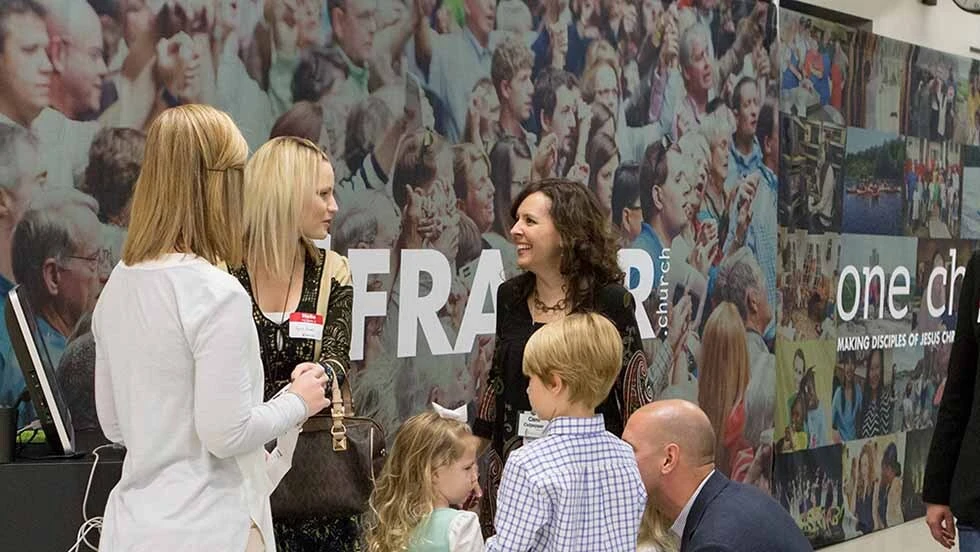
Standing under baskets and electronic scoreboards in a school gym, Ryan Butz lifted his hands in prayer during an Authentic Life Church service. "The church of God is not about the building. It's the people," said Butz, who enjoys the unconventional setting. "I feel a very close connection to the people here. I hate cookie-cutter things because they're all the same. And this is definitely not the same." More and more congregations like Authentic Life have become "mobile" churches in the economic downturn, choosing to lease space in schools, theaters and other nontraditional worship spaces instead of buying property or building new churches. Currently, about 248 churches in the Twin Cities metro area meet in schools or other temporary leased venues -- about 7 percent of the 3,399 total churches in the Twin Cities, according to John Mayer, executive director of the nonprofit City Vision, a Christian organization that tracks local religious data. Going mobile saves money and allows churches to grow at a quicker pace, but it's also labor intensive. For weekend services, volunteers pack trailers with musical instruments, speaker systems, lights, chairs and other equipment. Then they haul it to mobile sites, unload it all and set up for worship. The majority of churches across the country still own and occupy traditional church spaces. But growing megachurches, as well as fledgling churches, have increasingly turned to the mobile model in recent years.

Less costly way to worship

Ken Olson, senior pastor at Authentic Life, which has nearly 70 members, said the congregation has been meeting in the Hopkins West Junior High gym for nearly two years. The church had been leasing a more traditional church building in Orono for $7,000 a month. At the school, they pay around $2,000 a month. "I studied other churches and what they had done," said Olson. "It still was a little scary. But the more I thought about it ... it just made sense financially, it made sense location-wise, it made sense the kind of church we wanted to be, focused around community and relationships ... giving back." With the money saved on rent, Olson said Authentic Life has been able to put more resources into the church's mission work of helping those in need. They've donated m oney for supplies at local schools, supplied Thanksgiving meals to the needy, and assisted unemployed people looking for work. Going mobile has meant church volunteers like Butz, who serves as Authentic Life's stage manager, must show up about two hours before each 10 a.m. Sunday service and unload a 24-foot box trailer filled with the church's electronics and other equipment needed for worship. Bleachers are pushed against walls and folding chairs are set up in front of the church's stage area. Church band members set up drums, guitars, sound systems, lights and other gear, and rehearse for about an hour before the service starts. Olson, who envisions Authentic Life remaining mobile for a little while longer, said he would eventually like to have a permanent home. Though there's a lot of "grabbing cords, running up and down the stage," Butz says he's enjoyed bonding with fellow church members: "It's not like you're at work or anything. We're all there 'cause we want to be there. There's a really close relationship with everyone." Epic Life Church's congregation of about 80 has been meeting in the Andover Cinema movie theater about two years, said Skip Crust, lead pastor. The new church looked at property it could have rented full time but decided on the theater, mainly because of the $900-a-month rent. "We were looking at a place that would have cost about $3,000 a month," he said. "But I could not justify the cost. You can call any pastor in the Twin Cities and they're going to tell you they're struggling with their budget. And we're no different. I would be perfectly content to continue meeting in a mobile location for the remainder of my ministry." Crust also sees the social benefits of mobility: "The biggest advantage it has is that every week I get to spend two hours before church hanging out with people that I love and care about. There's a camaraderie that comes with setting up and tearing down every week you don't get in a permanent site. There's no place in the Bible where it teaches that folks should meet in a building."

Helping churches go mobile

To make the transition to a mobile church, Authentic Life turned to the California-based business Church on Wheels. The company sells electronics, sound systems and other equipment to congregations, and helps them design and lay out mobile systems. Costs for their services can range from $30,000 to $100,000. Eric Bako, lead sales consultant for Church on Wheels, said the company has serviced hundreds of churches throughout the country and sees more congregations staying mobile longer in the down economy. "In these economic times, it's rough to ask members for money for a building project," Bako said. "Because usually that's above and beyond their normal tithing." With mobile churches, "you're creating a brand new church home out of not a lot of resources. There's just a lot of value in it." Scott McConnell, director of Lifeway Research, a Christian research firm that tracks church trends throughout the United States, said besides megachurches and start-ups -- or "church plants" -- there's another type of congregation attracted to the mobile model. "We are starting to hear some folks going against the grain and saying owning a building is not a requirement," he said. "Instead of investing in physical assets, we're going to continue investing in ministry assets. We're going to a long-term plan to rent, not own. That's probably the newest phenomenon, to actually hear some churches that really by strategy are planning to never own a building." McConnell notes churches have always been about people and their relationship with God: "In America, church has become very tied to a place. And yet I think there's a generation that's rediscovering, it doesn't have to be a building with a steeple and a red door. It is the people ... as long as we can have a space that allows us to do the things we need to do, worshipping God together."


Crosspointe Winterpark, FL

Fox New Orlando, www.myfoxorlando.com , shined the spot light on Crosspointe Church in Winterpark, FL and on Church on Wheels.


Central Penninsula Church Mellbrae, CA

Growing Foster City church expands to Millbrae

By Christine Morente
San Mateo County Times
Posted: 01/14/2009 05:20:55 PM PST
Updated: 01/15/2009 06:36:36 AM PST

MILLBRAE — Close to 400 people got their Sunday jolt of Christ's love and wisdom inside a dark cavernous high school auditorium.

Pastor Mark Mitchell of Central Peninsula Church (CPC) welcomed them as pilgrims assigned to reach out to the city's lost and unchurched.

"This is a tough place to make it as a new church," he said at the inaugural service of its new satellite campus. "We do this for the glory of God, for the furtherance of the Gospel of Jesus Christ."

Consistent standing-room only Sunday services at the main campus in Foster City prompted the nondenominational evangelical church to expand, and it chose Mills High School.

In two years, the church wants to open a satellite in Redwood City or San Carlos.

"We have a desire to become an integral part of the community," said Rob Hall, the Millbrae campus pastor, last week. "There are more churches that close their doors every year than those opening their doors."

Evangelical churches have been blessed with steady growth over the past decade.

However, pews fill up quicker during a bad economy.

David Beckworth, an assistant professor of economics at Texas State University, said that during each recession cycle between 1968 and 2004, growth in evangelical churches jumped 50 percent.

"It's a great time to do what we're doing," Hall said. "People are saying, 'I trusted in my 401K, in my investments and now it's all crumbling. What do I do now?'"

McGreevy of CPC agreed.

"(The Sept. 11, 2001, attacks) was a wake-up call for people to get their life in order," the 59-year-old said. "We've experienced that again with the economy."

Mitchell said expanding is the right thing to do despite being in "the most difficult financial climate since the Great Depression."

He credited God for working behind the scenes to open the Millbrae campus.

"We looked at this theater and knew we could make it work," said Mitchell, who stood on stage next to a screen that projected Bible passages.

He said people may be sad to leave the Foster City congregation.

"There's pain in going; there's pain staying," Mitchell said. "But when God stirs, you have to go; you have to let go."

CPC, which is more than 40 years old, was once a portable church. Mitchell joked that its motto back then was: "We dare you to find us."

Members met in various places around San Mateo and Foster City before settling into its permanent home at 1005 Shell Blvd.

In 2001, the congregation built a 625-seat sanctuary.

CPC is now one of the larger churches on the Peninsula, with a congregation of about 1,700 people.

A few years ago, church elders began talking about going into other communities and making an impact.

The search narrowed down to Millbrae because it lacked a "healthy, vibrant and young church," Hall said.

"There is a lot of lost, hurting and broken people who have gone through a lot," he added. "It's a place where it's OK to not be OK. We have a 'come as you' are attitude."

Marianne Breaux, of Pacifica, has been going to CPC in Foster City for 20 years. She said it was wonderful to see so many people inside the high school.

"People work for the Lord and have him in their hearts for life," the 75-year-old said. "Without him, nothing takes place."

Julie Hylink of San Bruno was one of the many newcomers to the young congregation. The 32-year-old has been "hopping around" looking for a church where she belongs.

"Hopefully, I'll land in the right area," she said. "I want a pastor that preaches well, and I want a church I can serve in. This (CPC Millbrae) seems to be a pretty good church that can help me develop my service."

Church services are at 11 a.m. Sundays in the Mills High School auditorium at 400 Murchison Drive, Millbrae. For details, call 650-439-1132 or visit cpcmillbrae.org.


Church on Wheels takes high road to good fortune, The Fresno Bee

Published online on Friday, May. 01, 2009
By Ron Orozco / The Fresno Bee

A Madera company is wheeling and dealing to make Sundays a little easier for some central San Joaquin Valley churches just starting up.

Sundays can be back-breakers for these churches. Unlike established churches that own property and buildings, start-up churches rent rooms at schools, office complexes, movie theaters, stores, banquet facilities and other places to hold Sunday services and children's programs.

But Sundays can be a big pain for church crews. They arrive a couple of hours before the service to set up all the equipment and then remain after the service to take everything down.

We're talking wooden crosses, sound boards, speakers, microphones, projectors, video screens, podiums, chairs and curtains. And partitions, toys and games need to be set up in the children's room.

It's a common angst. One or two new congregations launch monthly in the Valley.

A Madera company has a solution for taking a little of the worry away.

Church on Wheels sells church equipment and manufactures crates on wheels to easily move the equipment around.

Church on Wheels also sells and customizes trailers where churches can store the equipment during the week. Its parent company is HMC Display, which specializes in stanchions, portable staging, crowd control and promotional equipment and is based in Charlotte, N.C.

"We have the privilege and challenge of being allowed to help groups of people realize their dreams," says Mike Gardner, founder of Church on Wheels. "Like most dreams, they are often long on details, but very short on an implementation plan. This is where we come in."

One of the Valley's most recent portable congregations, Sequoia Community Church, says Church on Wheels is like a godsend. Church on Wheels has helped about 100 portable churches nationwide get started since 2001, including six in the Valley.

Sequoia Community Church holds services at the Sunnyside Health & Tennis facility in southeast Fresno, using Church on Wheels equipment and products, including the crates and a 24-foot Haulmark trailer.

"It really is an art," says Bryan Griffith, a member of Sequoia Community Church's leadership team. "You have the science part, where you crunch the numbers. The art is working the space into something beautiful. I've been so happy. It's overwhelming."

Nearly a year ago, Sequoia Community Church began working with Portable Church Industries, based in Troy, Mich. The company also customizes cargo and works with various vendors to sell church equipment and products.

The two sides, however, couldn't reach agreement on specific audio equipment or a price suitable to Sequoia Community Church, which has a tight budget.

Enter Church on Wheels.

Gardner and Pope met to learn the church's goals. Pope says his church's vision was to create a place where people can set aside their hang-ups about religion and focus on what it means to "get real in their relationship with God."

Gardner also examined the church's venue, the Sunnyside Health & Tennis facility.

"You look at the space and see what it lends itself to," Gardner says.

In the meantime, Sequoia Community Church began holding monthly preview services and outreach events to get to know southeast Fresnans. Church members held free car washes, barbecue lunches and free Christmas wrapping events.

Members also visited other Valley portable churches, October through January, to examine the equipment and products being used.

Then, they brainstormed with Gardner about their preferences for church services.

Worship leader Jeff Brannan said he preferred an earpiece enabling him to monitor sound changes rather than someone at the sound board. Got it, Gardner said.

Several people said they preferred the projectors set up at the back of the room. No way, Gardner said. Instead, Gardner said Church on Wheels would manufacture enclosures to house the projectors so they could be set up in the front - and not disturb anyone.

Griffith's wife, Kari, said she preferred equipment and products for the children's program only for nursery-age kids and toddlers. No big kids' stuff. Got it, Gardner said.

Church leaders also said they wanted to use a room's west wall as backdrop to the pulpit. No way, Gardner said. He suggested turning the room around to avoid glare from one set of windows. And using a black curtain as backdrop to the pulpit. Agreed.

"That curtain will help them because it creates a tighter space," Gardner says. "If people walk in and see the place isn't full, they'll think, 'Wow, the people here are struggling.' They also can expand."

Total cost: $30,000.

Gardner still shows up to help Sequoia Community Church crews. On a recent Sunday, he says he was concerned about crews getting burned out.

About six workers unloaded everything in the van in 10 minutes - and that's quick.

hey spent another 50 minutes setting up everything in two rooms. "They need to keep it under 45 minutes," Gardner says.

Sound checks were conducted as the worship team rehearsed for an hour. Everything was set to go 30 minutes before the service. So the crew stopped to pray in a circle.

Pope smiled from ear to ear when he saw nearly all 40 seats filled with worshippers. They joined in the singing when the worship team performed the songs, "Let the Praises Ring" and "Holy is the Lord, God Almighty." And they chuckled when Pope mixed humor into his sermon on Luke 7:36-50, when Jesus was anointed by a sinful woman.

Gardner smiled from the last row with his wife and children. Everything went without a hitch.

After the service ended, a worshipper, Nancy Griffith, said she enjoyed the service. "I love this set-up," she says. "It's easy to see the words on the screens. It felt like a nice little community."

Pope visited with worshippers as crews took everything down in less than 30 minutes.

"We're just a part of the movement of starting new churches," Pope says. "Someday, we'll have an opportunity to pass on this equipment to someone else. And we're not bound to this place. We're praying. Some day, we'll move on."